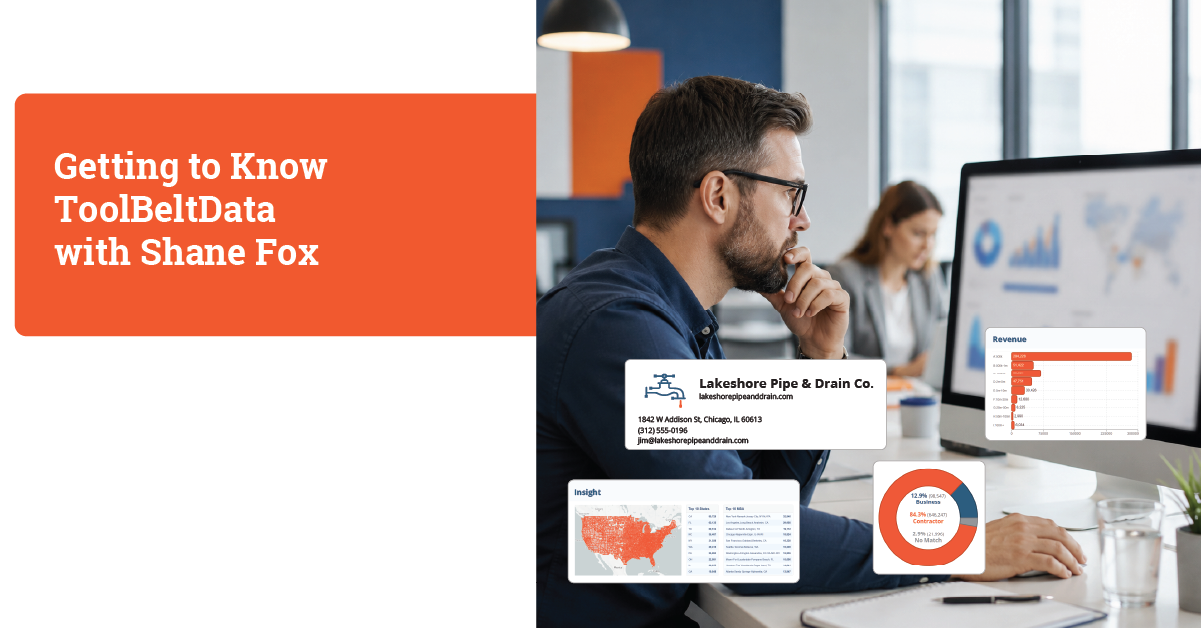
To help prospective customers better understand ToolBeltData, I connected with Shane Fox, Director of Customer Success, about what the platform does, who it helps, and how teams can use contractor intelligence to improve sales, marketing, and financial strategic planning. In this short interview Shane explains how ToolBeltData helps companies move beyond basic business listings and gain a deeper view of the residential construction market.
Kirill: For someone who is new to ToolBeltData, how would you explain what the platform does in simple terms?
Shane: At the simplest level, ToolBeltData is a contractor intelligence platform. That can mean different things depending on the customer, but it usually starts with helping companies understand the contractor/dealer market more clearly.
For example, some teams may simply want to know how many contractors of a specific trade type exist in a specific area, such as roofers in Idaho. But the platform goes much deeper than just total counts and basic firmographics. Our platform helps distributors, manufacturers, insurance companies, marketing agencies and other residential construction ecosystem businesses learn useful details about dealers/contractors, including what brands they install, how large they are, what other dealers or contractors they work with, whether they are licensed, how many permits they have pulled for a given timeframe, and much more.
The possibilities are broad because the platform gives teams a way to dig into the information they need about both companies and people working in the residential trades.
Kirill: What are a few common use cases for manufacturers and distributors?
Shane: One of the strengths of ToolBeltData is that it is versatile across different teams and stakeholders.
For a sales team, the use case can be straightforward: they need leads. They want contractors to call on who fit their ideal customer profile. ToolBeltData can help them identify those accounts and understand which ones are worth prioritizing.
For finance leaders, the platform can support broader market analysis. A CFO might use the data to identify the total addressable market, evaluate pricing opportunities, or better understand where the company ships or sells.
For marketing teams, the value often comes from improving audience quality. Many teams are still building generic outbound audiences. ToolBeltData helps them get more granular so they can present the right offer to the right target.
Kirill: Who is the primary audience for ToolBeltData today?
Shane: The core audience has been residential construction manufacturers and distributors. Those customers have seen a lot of value from the platform and from the services around it.
That said, the use case is broader than manufacturers and distributors. Anyone who needs to talk to or target people working in the residential trades could benefit. We are starting to see that expand into other categories, including technology firms, banking, insurance, and other companies that serve or evaluate operators in the residential construction space.

Kirill: When prospects come to ToolBeltData, what problems are they usually trying to solve?
Shane: The most common challenge is a lack of awareness inside their existing customer base. Most companies have a CRM, but the data is often very dirty, incomplete, out of date, or lacks details and other information useful for decision-making. Other times, it means they do not have a clear view of the true number of prospects available to them.
That is usually where the conversation starts. From there, the data can support other use cases, such as offer management, territory planning, and prioritization. Not every territory has the same opportunity, so understanding where the richest pockets of prospects are can help companies focus their time and resources more effectively.
Kirill: Is there a customer use case that stands out as a particular win?
Shane: It is hard to pick just one because the use cases vary so much by customer. One pattern we see often is that a customer becomes interested in ToolBeltData for one specific reason, and then the value quickly expands into other areas once they see the scope and depth of the data we have available – many times people do not expect the level of depth we provide when they reach out for a demo.
The customers who get the most value are the ones who use our expertise, not just the platform. They ask questions about what data is available and how it can be applied. We also do our best to ask questions that help them think beyond the first use case. That often leads to opportunities they had not considered when they became a customer.
One example that comes to mind is a retail client with a very diverse customer base. They served consumers, businesses, and contractors of many types, and they wanted to segment those customers more intelligently so they could market to each group differently. ToolBeltData helped them separate those audiences into major customer types – consumer, business, and contractor – and then go deeper within each category. That micro-targeting created multiple wins because it allowed them to tailor their messaging and offers based on how each customer group actually used their products.
Kirill: Budget can be a challenge for sales and marketing teams. How could someone frame ToolBeltData as an investment rather than an expense?
Shane: The customers who have the easiest time seeing the value are usually the ones who already know their key metrics. If they know their cost per lead, cost per close, and lifetime value of a customer, the ROI conversation becomes much more straightforward.
When those numbers are clear, it is usually easy to show how small improvements in efficiency can more than cover the cost of the data and services. Even a slight lift in sales, targeting, lead quality, or digital marketing efficiency can make the investment pay for itself. One of our long time clients recently reported a six figure return on a digital campaign using our data to optimize targeting, and they were thrilled!
For customers that do not yet have a strong handle on those metrics, the sales cycle may take a little longer because they need to define the baseline first. We can help them think through questions such as how many prospects are available, what customer intelligence would be useful, and what would happen if average sales per customer increased from one number to another. Once they start modeling those scenarios, the ROI becomes much easier to see.
Kirill: What does onboarding typically look like, and how quickly can a customer expect to see value?
Shane: Customers can see value almost immediately. Once a contract is signed, access to the platform is typically available within one to two business days. New customers can begin accessing and using the data right away.
They also get access to our team for professional services and strategic support. Sometimes that takes a little longer, especially if we are helping plan a specific outbound strategy or campaign. But the data itself is available quickly. The timing mostly depends on how long it takes the customer to execute against the strategy they choose.
We work closely with every client to make sure their individual needs are met – and support them every step of the way unlike some SaaS companies where you sign up and never hear from anyone again. Our customer-centric, white-glove approach is one our customers find to be of great benefit.
Kirill: How flexible is the platform for different teams, workflows, and business needs?
Shane: There are two ways to think about flexibility – the teams using the data and the technical ways they access it.
On the team side, ToolBeltData can support multiple stakeholder groups inside the same company. Sales, marketing, finance, and other teams may all use the same data set, but they will focus on different attributes depending on their goals. We can help each group think through the strategy that matters most to them.
On the technical side, customers can access the data in several ways. Some use the data portal directly. Others receive flat files, make calls to the API, or connect through Snowflake. That makes the platform adaptable to a range of internal systems and workflows.
Kirill: Are there any misconceptions prospects have before they see ToolBeltData in action?
Shane: A common misconception is that ToolBeltData is just another general business directory. Many people are familiar with broad business data providers such as Dun & Bradstreet, ZoomInfo, or Data Axle, so they expect name, address, phone number, website, and other basic listing information.
ToolBeltData is different because it specializes in residential construction. We are not trying to be a general-purpose business file. Our purpose is more niche and more granular.
Once prospects see the platform, they usually realize it is not just another business listing. It gives them a deeper view of companies involved in the residential trades, with details they often have not seen available elsewhere.
Kirill: What are some of the variables or data points that prospects are surprised to find in the platform?
Shane: Brand affinity is a big one. Customers often want to know what brands a contractor installs or uses in projects, and that information can be very valuable.
Permit data is another important example. Customers can look at what kinds of permits have been pulled and, in many cases, see detailed information about a specific job. Licensing information, license types, ratings, and reviews are also highly useful, especially for teams that want to identify contractors doing quality work and avoid those that are not a fit.
There are more than 300 attributes in the file, but those are some of the data points that consistently surprise customers. That is usually when we hear the “oohs” and “ahs” during a demo.
Another important differentiator is first-party activity data from the Buildertrend application. That project activity data is especially granular because it is entered by the builder or subcontractor directly in the platform. In other words, it is coming from the person doing the work in the field, not just from outside inference.
Kirill: What should someone expect from a ToolBeltData demo?
Shane: The first meeting usually starts with a general overview of the data sets we have available and the ways customers can access them. We keep that overview broad because there is too much depth to cover in one meeting.
The most valuable part of the demo is the discovery conversation. We ask questions about the gaps in a prospect’s current customer intelligence, prospecting data, or marketing analytics. We want them to think about where better contractor intelligence could improve their sales or marketing process. I often ask prospects to think about their perfect world: if they could improve their sales or marketing process in any way, what would they change? What is the hardest problem to solve? Bring that challenge to us, and we can look at whether ToolBeltData can help.