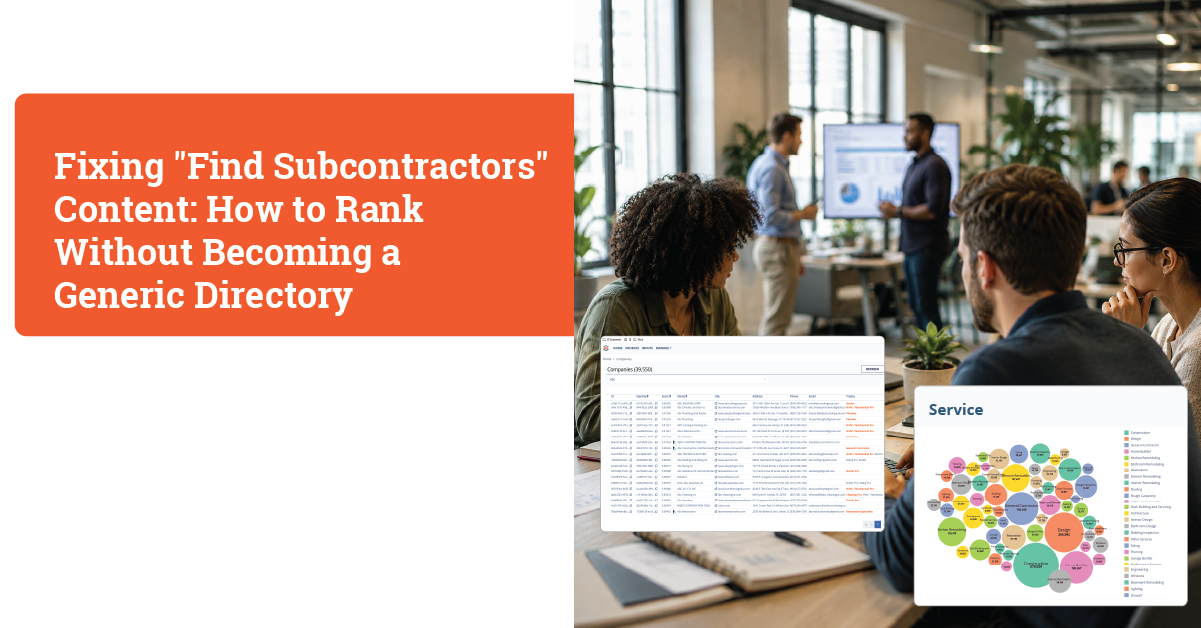
If you’re creating content around the keyword ‘find subcontractors,’ publishing another page filled with contractor names isn’t likely to help you stand out.
Directories dominate search results, AI can summarize basic business listings in seconds and static pages become outdated almost as quickly as they’re published. For manufacturers and distributors selling into residential construction, simply creating another construction subcontractors list isn’t enough to attract qualified buyers or demonstrate expertise.
The opportunity isn’t to become another directory. It’s to create content that helps sales and marketing teams understand which contractors fit their market, where activity is growing and how to validate prospects before investing time and budget.
The companies that earn lasting visibility in search provide context, analysis and practical insights that go beyond a basic list of businesses.
Why Generic Subcontractor Lists No Longer Stand Out
A basic subcontractor list answers one question: “Who exists?” Unfortunately, that’s the same question thousands of websites already answer.
Sales and marketing leaders need more than names and phone numbers. They want to know whether contractors are active, which trades are growing, where residential work is expanding and which companies resemble their ideal customers. Those answers require more than a spreadsheet.
Construction remains highly fragmented, with the overwhelming majority of firms operating as small businesses. That makes identifying the right contractors significantly harder than simply downloading a list. Labor shortages add another layer of complexity by limiting contractor capacity across nearly every trade. According to the Associated Builders and Contractors, the industry needed to attract approximately 439,000 net new workers in 2025 to meet anticipated demand. ABC also warns that if the industry falls short, labor costs will continue to rise, construction costs will increase and fewer projects will be financially feasible.
Instead of publishing another directory, create content that explains what buyers should evaluate after they find potential subcontractors. That naturally leads readers toward higher-value insights.
What Searchers Actually Want When They Search “Find Subcontractors”
Search intent has evolved.
Someone searching ‘find subcontractors’ rarely wants hundreds of random company names. They’re trying to solve a business problem.
That usually looks more like this:
- Find subcontractors in a specific trade.
- Identify contractors working in a target geography.
- Verify whether contractors are still active.
- Build a qualified sales prospect list.
- Compare opportunities across markets.
Each of those searches creates an opportunity to educate instead of simply listing businesses.
Your content becomes more valuable when it helps readers evaluate quality rather than quantity. That’s also much harder for AI-generated directory pages to replicate.
From an SEO perspective, search engines increasingly reward comprehensive content that satisfies intent instead of repeating information already available elsewhere.
As a result, pages built around contractor insights often create more lasting value than pages built around static listings.
Turn A List Into Contractor Intelligence
A construction subcontractors list should be the beginning of the conversation, not the end.
After introducing the concept, expand into the information sales and marketing teams actually need before launching campaigns.
Instead of stopping at a contractor’s name and location, explain how readers should evaluate trade specialization, geographic coverage, company size, recent business activity, licensing status and market trends. Those details help identify contractors that are the right fit instead of simply adding more names to a database.
This also creates natural opportunities to discuss contractor segmentation, territory planning and account prioritization without turning the article into a product pitch.
The more context your content provides, the more likely readers are to trust it as a decision-making resource.
Use Industry Data To Make Your Content Worth Reading
Anyone can publish a list of subcontractors. Far fewer companies publish analysis that helps readers understand how residential construction markets are changing.
Supporting your content with credible industry research gives readers valuable context while distinguishing your article from generic directories. Instead of relying on static business listings, reference data that explains market conditions, contractor activity and business changes over time.
For example:
- The U.S. Census Bureau’s Business Dynamics Statistics tracks business openings, closings, expansions and contractions each year, illustrating why contractor data requires ongoing validation instead of one-time updates.
- The U.S. Bureau of Labor Statistics regularly publishes employment projections by construction trade, helping manufacturers and distributors understand where demand for skilled contractors is expected to grow.
- Regional building permit activity from the U.S. Census Bureau can reveal where residential construction is accelerating, providing additional context beyond a simple contractor directory.
Rather than publishing another construction subcontractors list, use trusted industry data to explain what readers should look for after they identify potential contractors. That additional context builds credibility, demonstrates expertise and creates content that remains valuable long after a directory has become outdated.
Move Beyond A Basic Subcontractor List
Finding subcontractors is only one step in the process.
Once someone identifies potential contractors, the next challenge is determining whether they’re the right fit. That’s where your content can provide value that generic directories simply can’t.
Rather than ending with a subcontractor list, explain how readers can evaluate contractor qualifications, verify business information, understand trade specialization and prioritize companies that align with their target market. You can also discuss how geographic coverage, residential experience and recent business activity help paint a more complete picture than a name and phone number alone.
That additional context transforms your content from a searchable directory into a practical resource for sales and marketing teams. It also creates natural opportunities to introduce related topics like contractor segmentation, territory planning and market analysis while staying focused on helping readers make smarter decisions.
As readers move from finding contractors to qualifying them, your content becomes more valuable at every stage of the buying journey.
Support Your Content With Related Resources
Search engines reward topical authority, not just individual pages.
As you build content around finding subcontractors, look for opportunities to answer the questions readers naturally ask next. Internal links help search engines understand your expertise while encouraging visitors to continue exploring related topics.
For example, you might link to content about:
- Building a qualified contractor database.
- Validating contractor business information.
- Contractor segmentation strategies.
- Regional construction market trends.
- Residential contractor intelligence.
These supporting articles create a stronger content ecosystem than a collection of city-by-city contractor directories. They also give readers practical next steps instead of ending the conversation after they’ve found a list of companies.
A well-connected library of educational content builds authority over time while helping readers solve increasingly complex challenges.
Build Content That Delivers More Than A Directory
The strongest content doesn’t compete with contractor directories by trying to publish more names. It provides the context that directories can’t.
For manufacturers and distributors, that means helping readers understand which contractors fit their market, how residential construction trends are changing and why validating contractor information matters before investing in outreach.
As AI continues making basic business listings easier to generate, content that combines industry data, practical guidance and contractor intelligence will be better positioned to earn both search visibility and reader trust.
Ready to move beyond generic directories? Contact ToolBeltData to start a free trial and see how ToolBeltData helps manufacturers and distributors identify, validate and prioritize qualified contractors using contractor intelligence and market data.